
Discover: Gaping Gill
-
Date posted: 23/05/2024
-
Time to read: 8 minutes

Charlotte Mudd
I am Creative Content Producer at the Yorkshire Dales National Park Authority. I am responsible for the digital graphic and video content produced here. I have been involved in the Yorkshire Dales National Park Authority for three years, starting as a volunteer, then completing a creative content apprenticeship, to now securing a permanent position. The best bits about my job are: I can be creative, I am able to get out and about in nature, and I get to film in the beautiful Yorkshire Dales!

Last year as part of my role at the Yorkshire Dales National Park Authority, I was involved with creating a film to showcase the special qualities of the Yorkshire Dales National Park. As part of this, I visited the locations across the Yorkshire Dales National Park which showcased the best examples of each of these special qualities, such as Malham for limestone scenery, Hardraw Force for the highest unbroken waterfall above-ground (30m), and the famous Gaping Gill – the second largest natural caverns, and home to the highest unbroken waterfall (100m) in the UK.
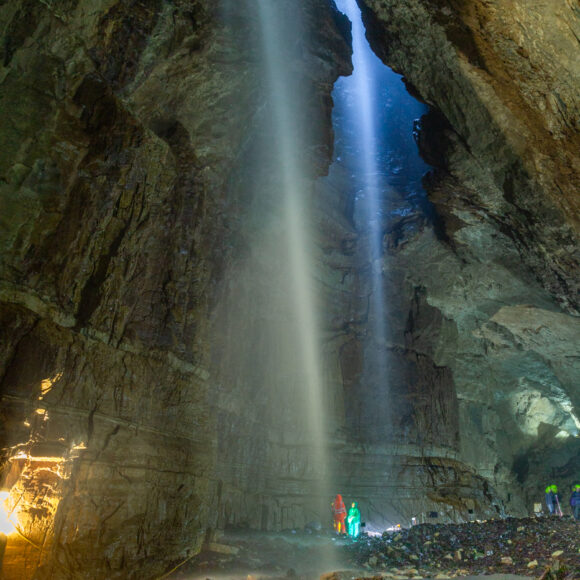
Gaping Gill
Descending Gaping Gill was a stand-out memory of that day, amongst many beautiful locations, Gaping Gill was the most magnificent of all and a once-in-a-lifetime experience.
Caves and potholes form a major part of our limestone landscape. This landscape is known as karst and the Yorkshire Dales National Park is the finest and most extensive example in Britain. There are over 2,500 known caves in the Dales including the longest system in Britain, The Three Counties, and the famous large chamber of Gaping Gill.
The Gaping Gill winch meet is held twice a year by two small local caving clubs. For a one-week period in May and August, the Bradford Pothole Club and Craven Pothole Club run a ‘winch meet’ event, at which they set up a winch to allow members of the public to descend into the chamber. The chair winch carries one person at a time, 100m down next to Fell Beck – the highest unbroken waterfall in the UK (so you get a bit wet!) Places are a first come first served basis, so you have to get up early and hike halfway up Ingleborough to get a place!
Otherwise, Gaping Gill can only be accessed by expert cavers as it is a 31m abseil down to the floor of the cavern. The cavern itself is huge -129m long, 31m high, and 25m wide, (large enough to accommodate St Paul’s Cathedral) and has three waterfalls cascading into it. Other than the waterfalls the cavern is an open space and the noise of the waterfalls echos around – I remember it being quite loud, you had to shout to hear each other over the sound of the water.
You can find out more about the ‘winch meet’ at Gaping Gill at the Council of Northern Caving Club.
Specific details, including upcoming dates, can be found on the club websites:
- May meet: Bradford Pothole Club
- August meet: Craven Pothole Club
Learn more and explore the special qualities of the Yorkshire Dales National Park.
Good news for nature August roundup 🌿
This time there’s cats, bugs and birds. There’s so many spectacular sightings, breakthroughs and results for wildlife every single day in our National Parks.
Here are just four pieces of recent good news to make you smile this weekend. Share with someone who loves nature to spread the positivity 💚
#GoodNews #NationalParks #Wildlife


Three years ago, beavers returned to the Cairngorms. 🦫
After more than 400 years away, the first beaver family was released into the National Park in December 2023.
Since then, something special has happened: they’ve settled, spread and started breeding. There are now around 72 beavers in the Cairngorms, including kits born in the wild.
And they’re not just living in the landscape, they’re helping to shape it. By creating wetlands and changing waterways, beavers can help hold and slow water, and create habitats that benefit a whole host of other species. 🌿
It’s a brilliant example of how our National Parks can play a vital role in nature recovery - and what’s possible when people work together to bring species back and create healthier, more resilient landscapes for people and nature.
#NationalParks #Cairngorms #Beavers #NatureRecovery

September is a great time to try nature journaling 📝🍂
A simple form of mindfulness, nature journaling encourages us to slow down and notice what’s happening in the world around us - from the first changing leaves and fungi appearing to the birds we hear and the changing light.
It doesn’t have to be complicated. It’s simply about taking a moment to be present, pay attention and connect with nature.
All you need is a notebook, a pen and somewhere outdoors. Our National Parks are pretty good spots for it, too. 👀
Have you ever tried nature journaling? It’s another way our National Parks are helping people to unwind, everyday.
#NatureJournaling #NationalParks #Mindfulness

🦇When the sun goes down, a whole new world comes to life.
Our National Parks are home to many rare species, including wildlife that can be much harder to spot. The New Forest is home to 14 of the UK’s 18 species of bat, from tiny pipistrelles to some of our rarer woodland species.
Bats depend on a mosaic of habitats to survive, and across the UK’s 15 National Parks, work is happening to protect the places wildlife depends on – even when we don’t always see it.
This International Bat Night, meet just some of the bats our Parks are home to.
📸
1. Soprano Pipistrelle – Russell Wynn / Wild New Forest
2. Soprano Pipistrelle – New Forest National Park
3. Barbastelle – Hugh Clark/Bat Conservation Trust
#BatsOfInstagram #NewForest #InternationalBatNight

15 National Parks. Countless landscapes and communities.💚
Working farmland. Wild coastlines. Woodland paths. Places shaped by generations of people.
Our National Parks are incredibly diverse and not just in the landscapes they protect, but in the people, nature, heritage and stories that make each one unique.
#NationalParksUK #UKNature

Look a little closer and you’ll find a landscape full of life at the Peak District National Park. 🌿
From dippers, ring ouzels and mountain hares in the uplands, to curlews calling across the moorlands and meadow brown butterflies in grasslands, these are just five of the many species you can see in the Peak District this season.
Protecting the special landscapes across our 15 National Padks means protecting the variety of wildlife relying on these habitats as their homes.
Which would you most like to spot? 👀
📷
1. Mountain Hare
2. Curlew
3. Ring Ouzel
4. Meadow Brown Butterfly - Alex Hyde
5. Dipper - Tom Marshall
#PeakDistrict #Wildlife #NationalParksUK

💧It’s World Water Week, and water connects our National Parks in more ways than we might realise.
We know our Parks are full of many beautiful waterscapes, but they’re not just spectacular views.
Water environments offer many hidden benefits to our landscapes, including supporting ecosystems, climate resilience and communities.
Swipe to discover just some of the ways water matters.🌿
Do any of them surprise you?
#NationalParks #WorldWaterWeek #Nature #Biodiversity

💭You might have heard of biodiversity, but what does it actually mean?
It’s the variety of life around us from plants and insects in a meadow to birds, mammals, fungi and the tiny organisms we can’t even see.
But it’s not just a list of species - it’s the intricate web of relationships between them, and our National Parks are home to an incredible diversity of life.
Protecting biodiversity means protecting that web of life.
📸 An adder in @southdownsnp by Simon Watkins.🐍
#Biodiversity #NatureLovers
