
Lookwild: On the Nightshift
-
Date posted: 30/07/2024
-
Time to read: 8 minutes
One of the joys of my job is working with young people and helping them to connect with nature. The other night I was lucky enough to help our Engagement Ranger to deliver a Dartmoor Youth Rangers session surveying the woods for nightjar, an enigmatic bird. We gathered in the car park of a local woodland on a perfect summer’s evening. It was a welcome change from the months of rain that have impacted many of our activities!

The midges
As we waited for everyone to arrive there was one small frustration: the midges. Clouds of them, forming rippling shadows around each one of us. And slowly one by one each of us began to zip and button up our clothing, don hats and hoods and trade in various repellents to keep the midges from biting so that only our eyes were on show.
The midges themselves are fascinating. The larvae live in wet, damp peaty soils – our upland moors are the perfect habitat and they love warm damp springs. The overwintering larvae lives in the soil feeding on rotting plant material. It then pupates and emerges in late spring. On still, humid days, as the sun goes down, the males gather in clouds hoping to attract a female. When they do, they tumble out of the cloud to mate. It’s the female that bites – she needs the blood to give her eggs enough nutrients to start the cycle of life again. She senses the perfect snack through the CO₂ we breathe out and then sets to work to bite and drink our blood. As she does this she lets the other females know of our presence by giving off an appropriate pheromone, hence the clouds of midges attracted to us. Breezy nights and keeping moving are the best ways to avoid being bitten – they struggle to fly that fast!
So what’s the point of midges you might ask? Well, they are an important part of our ecosystems – they have a role in recycling rotting vegetation and they can be a source of food for bats and birds like the nightjar.
Observation by ©Albert Cardona
Nightjars
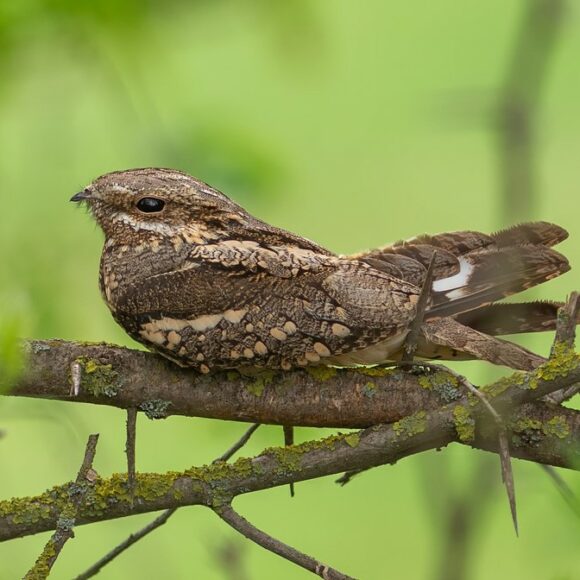
By now all the Youth Rangers had arrived so as the sun dropped behind the hills across the valley we split up into small survey groups each taking a different path through the conifer plantation. Nightjars particularly like young plantation woodland and heathland edges as they are ground nesting birds. They are incredibly well camouflaged with beautiful silvery brown and cream bark-like markings so that they can blend in perfectly with a woodland floor. With this in mind, we stayed clearly on the forest tracks to avoid unwittingly disturbing a nest.
Because of this, the best way to see them is to listen for them. You can listen to a nightjar call here.
Equipped with maps of the area and clipboards our Youth Rangers listened intently to the night sky and then suddenly through hushed voices we heard our first nightjar of the evening. Its song, a churring sound almost like a car switching up and down through the gears can contain up to 1,900 notes a minute. At first it sounded far off in the distance but as this nightjar stopped calling another took over, continuing the exotic song though the night air all around us.
Observation by © Vyacheslav Luzanov

Moments later, another flew across the nearby tree tops and then banked and swooped low as it made a silent circle around us, hoovering up insects. They are about the same size as a kestrel or cuckoo and looked dramatic silhouetted against the twilight sky. We marked it down on our map and waited in anticipation for more encounters.
Nightjars are summer visitors arriving in May and depart for the Democratic Republic of Congo in late August. The scientific Latin name for them (Caprimulgidae) means goatsucker because in the past some people believed that they fed on the milk of goats at night because they often saw them where their goats were.
As we slowly made our way back to the start we were eager to share our results and experiences. Everyone agreed that it had been an exciting encounter with a rare and wonderful bird. We shared our survey results which will help the land manager to protect their habitat, thanked our guide, and we mostly forgot about the midges.
Observation © Oscar Wainwright
Look out for guided night walks near you. A guide can help you spot things you might miss and can find the best routes to suit everyone’s needs, as well as ensuring that you don’t stray off the trail. And if you don’t see a nightjar there are always plenty of other things to listen and look out for.
If you’ve been inspired to get out into nature, you can share any photos or observations with us and get featured on our social or our newsletter! Send your observations to connect@nationalparks.uk. Join iNaturalist and start identifying nature near you today! LookWild is a brilliant citizen science project that helps contribute to our data and knowledge of wildlife and habitat health across the UK.
This blog was written by Andy BaileyOutreach and Engagement Officer at Dartmoor National Park Authority
What if Middle-earth’s Rangers had more in common with National Park Rangers than we might think?
Of course, our National Park Rangers have a little less to worry about than Aragorn and his fellow Rangers.
But they do both know their landscapes well, protect the places they love and guide others to find their way.
Across the UK’s 15 National Parks, our Rangers are taking action every day. They may not be defending the Shire from the forces of darkness, but they certainly do an incredibly important job. 💚
#MiddleEarth #Rangers #NationalParksUK


15 National Parks. One shared challenge. Our climate is changing, and with it comes an increased risk of wildfire across our landscapes.
That’s why we’ve committed to taking action through our new Wildfire Management Position Statement. Together, the National Parks will work to support nature recovery to help manage wildfire risk, plan for and strengthen wildfire response and coordination, improve risk management and preparedness, and share clear, consistent public messaging.
But we can’t do it alone.
Communities, organisations, land managers and visitors all have a role to play in reducing wildfire risk. By working together, we can help protect our National Parks and prepare for a future where hotter, drier weather may increase the risk of wildfire.
Read the full statement by clicking on the link in our bio 🔗
Photos:
Slide 1 - Fighting the Glenmore wildfire, © Ed Smith. Slide 2 - Fighting the Glenmore wildfire, © Malcolm Smith. Slide 3 - View across Loch Morlich during Glenmore wildfire, July 2026, © Brenna Jessie. Slide 4 - Fighting the Glenmore wildfire, © Malcolm Smith. Slide 5 - View from the cab of a tractor aiding in fighting the wildfire in the Cairngorms National Park, CPNA. Slide 5 - Firefighting vehicles at the Glenmore wildfire, © Malcolm Smith.
#Wildfires #NationalParksUK

It’s not every day you get to see one of our National Parks in biscuit form on @britishbakeoff!
Last night, The Great British Bake Off contestant @itsdoctoryan created a beautiful biscuit mosaic inspired by the Broads National Park, perfectly capturing the view at St Benet’s Mill, Thurne.
And it wasn’t just a feast for the eyes as the mosaic was made using treacle and ginger, honey and lemon, cocoa and malted milk, and pistachio biscuits.
Two great things combined: a beautiful National Park view and delicious biscuits. What could be better than that? 💚
Photo: Channel 4
#GBBO #BakeOff #NorfolkBroads @broadsnationalpark

You’ve likely heard of one - but what does it actually do?
Our 15 Parks wouldn’t be able to function without the authorities working behind the scenes to keep them running.
And each authority relies on people. People within the community, volunteers, staff and members. People that run businesses, or partner as organisations. People that are skilled and knowledgeable in a variety of areas from wildlife to accessibility.
Our National Parks are full of people and action, and it’s the Authorities that bring them all together.
💚
#NationalParksUK #NationalParkAuthorities

The Yorkshire Dales has one of the highest concentrations of caves and caverns of any of our 15 National Parks - a whole landscape hiding beneath the ground.
Our National Parks don’t just protect and preserve the landscapes we see every day. They also help care for historic and unique places discovered by our ancestors, like Ingleborough Cave and Gaping Gill, both of which were shrouded in myth and legend until they were explored by Victorians in the 1800s.
There’s so much more to our National Parks than meets the eye and sometimes, quite literally beneath the surface 👀
#YorkshireDales #GapingGill #Ingleborough

A week on from National Parks UK’s Big Volunteer Weekend, we’re still celebrating the people who make a difference across our National Parks.
Last weekend, hundreds of people came together across all 15 National Parks to give their time, share their skills and support our landscapes.
But volunteering in our National Parks doesn’t happen just one weekend a year. All year round, volunteers play an incredible variety of roles – from leading guided walks and supporting education, to conservation, planting and caring for our landscapes.
Every volunteer makes a valuable contribution to protecting our natural and cultural heritage. We simply couldn’t do what we do without you. 💚
So, to all our volunteers: thank you for your time, energy, enthusiasm and everything you bring to our National Parks.
If you know someone who volunteers in a National Park, help us spread the thanks by sharing this post. 🌿
#Volunteers #NationalParks #NationalParksUK

Mae’r Bele yn un o famaliaid prinnaf Cymru, ond mae eu niferoedd yn tyfu yn raddol. Mae hynny’n newyddion da i’n coetiroedd ac i’r Parciau Cenedlaethol, sy’n darparu rhai o’r cynefinoedd pwysicaf ar gyfer bywyd gwyllt ledled Cymru a Phrydain.
Ym Mannau Brycheiniog, mae’r prosiect adfer wedi gosod blychau nythu yn y coed, ac mae gwaith monitro wedi nodi presenoldeb y Bele, gan gynnwys grwpiau teuluol. Mae’r ffilm arbennig hon yn dangos un ohonynt ar waith. 🐾
Mae’n atgof hyfryd o’r hyn sy’n bosibl pan ddaw coetiroedd iach a gwaith cadwraeth arbenigol at ei gilydd i roi’r gofod sydd ei angen ar rywogaethau prin i wella.
Pine Martens are one of Wales’ rarest mammals, but they’re slowly making a comeback. That’s good news for our woodlands, and for National Parks, which provide some of the most important habitats for wildlife across Wales and Britain.
In Bannau Brycheiniog (the Brecon Beacons), the recovery project has installed treetop den boxes, with monitoring identifying pine martens, including family groups. This special footage shows one in action. 🐾
It’s a lovely reminder of what can happen when healthy woodlands and specialist conservation work come together to give rare species the space they need to recover.
#BreconBeacons #BannauBrycheiniog #PineMartins #Wales

It’s the Autumn Equinox 🍂
Our National Parks are always changing in time with the rhythm of nature, but this becomes particularly noticeable when autumn arrives.
Deer begin to rut, spiders’ cobwebs glisten in the fresh light, fungi become more prominent, and leaves begin to change colour.
What changes have you noticed so far? 🧡
#Autumn #AutumnEquinox #NationalParks
